This is a list of available software and hardware tools that are designed for or are particularly suited to various kinds of security assessment and security testing. == Operating systems and tool suites == Several operating systems and tool suites provide bundles of tools useful for various types of security assessment. === Operating system distributions === Kali Linux (formerly BackTrack), a penetration-test-focused Linux distribution based on Debian Pentoo, a penetration-test-focused Linux distribution based on Gentoo ParrotOS, a Linux distro focused on penetration testing, forensics, and online anonymity. == Tools ==
Lazy learning
(Not to be confused with the lazy learning regime, see Neural tangent kernel). In machine learning, lazy learning is a learning method in which generalization of the training data is, in theory, delayed until a query is made to the system, as opposed to eager learning, where the system tries to generalize the training data before receiving queries. The primary motivation for employing lazy learning, as in the K-nearest neighbors algorithm, used by online recommendation systems ("people who viewed/purchased/listened to this movie/item/tune also ...") is that the data set is continuously updated with new entries (e.g., new items for sale at Amazon, new movies to view at Netflix, new clips at YouTube, new music at Spotify or Pandora). Because of the continuous update, the "training data" would be rendered obsolete in a relatively short time especially in areas like books and movies, where new best-sellers or hit movies/music are published/released continuously. Therefore, one cannot really talk of a "training phase". Lazy classifiers are most useful for large, continuously changing datasets with few attributes that are commonly queried. Specifically, even if a large set of attributes exist - for example, books have a year of publication, author/s, publisher, title, edition, ISBN, selling price, etc. - recommendation queries rely on far fewer attributes - e.g., purchase or viewing co-occurrence data, and user ratings of items purchased/viewed. == Advantages == The main advantage gained in employing a lazy learning method is that the target function will be approximated locally, such as in the k-nearest neighbor algorithm. Because the target function is approximated locally for each query to the system, lazy learning systems can simultaneously solve multiple problems and deal successfully with changes in the problem domain. At the same time they can reuse a lot of theoretical and applied results from linear regression modelling (notably PRESS statistic) and control. It is said that the advantage of this system is achieved if the predictions using a single training set are only developed for few objects. This can be demonstrated in the case of the k-NN technique, which is instance-based and function is only estimated locally. == Disadvantages == Theoretical disadvantages with lazy learning include: The large space requirement to store the entire training dataset. In practice, this is not an issue because of advances in hardware and the relatively small number of attributes (e.g., as co-occurrence frequency) that need to be stored. Particularly noisy training data increases the case base unnecessarily, because no abstraction is made during the training phase. In practice, as stated earlier, lazy learning is applied to situations where any learning performed in advance soon becomes obsolete because of changes in the data. Also, for the problems for which lazy learning is optimal, "noisy" data does not really occur - the purchaser of a book has either bought another book or hasn't. Lazy learning methods are usually slower to evaluate. In practice, for very large databases with high concurrency loads, the queries are not postponed until actual query time, but recomputed in advance on a periodic basis - e.g., nightly, in anticipation of future queries, and the answers stored. This way, the next time new queries are asked about existing entries in the database, the answers are merely looked up rapidly instead of having to be computed on the fly, which would almost certainly bring a high-concurrency multi-user system to its knees. Larger training data also entail increased cost. Particularly, there is the fixed amount of computational cost, where a processor can only process a limited amount of training data points. There are standard techniques to improve re-computation efficiency so that a particular answer is not recomputed unless the data that impact this answer has changed (e.g., new items, new purchases, new views). In other words, the stored answers are updated incrementally. This approach, used by large e-commerce or media sites, has long been used in the Entrez portal of the National Center for Biotechnology Information (NCBI) to precompute similarities between the different items in its large datasets: biological sequences, 3-D protein structures, published-article abstracts, etc. Because "find similar" queries are asked so frequently, the NCBI uses highly parallel hardware to perform nightly recomputation. The recomputation is performed only for new entries in the datasets against each other and against existing entries: the similarity between two existing entries need not be recomputed. == Examples of Lazy Learning Methods == K-nearest neighbors, which is a special case of instance-based learning. Local regression. Lazy naive Bayes rules, which are extensively used in commercial spam detection software. Here, the spammers keep getting smarter and revising their spamming strategies, and therefore the learning rules must also be continually updated.
Automaton
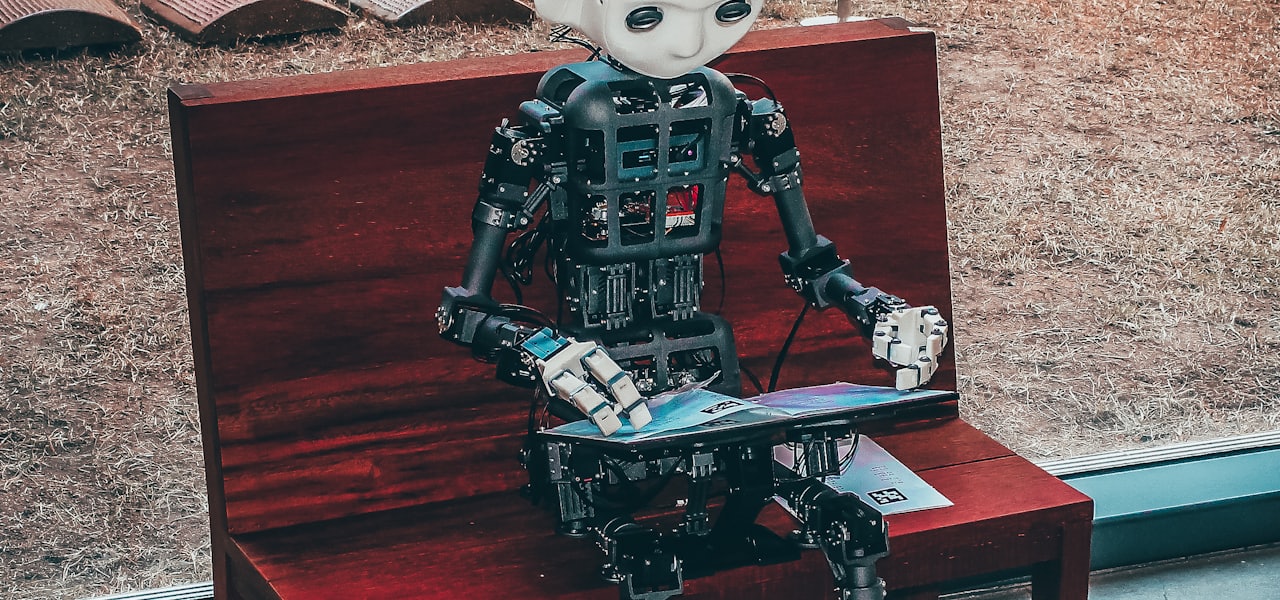
An automaton ( ; pl.: automata or automatons) is a relatively self-operating machine or control mechanism designed to automatically follow a sequence of operations or respond to predetermined instructions. Some automata, such as bellstrikers in mechanical clocks, are designed to give the illusion to the casual observer that they are operating under their own power or will, like a mechanical robot. The term has long been commonly associated with automated puppets that resemble moving humans or animals, built to impress and/or to entertain people. Animatronics are a modern type of automata with electronics, often used for the portrayal of characters or creatures in films and in theme park attractions. == Etymology == The word automaton is the latinization of the Ancient Greek automaton (αὐτόματον), which means "acting of one's own will". It was first used by Homer to describe an automatic door opening, or automatic movement of wheeled tripods. It is more often used to describe non-electronic moving machines, especially those that have been made to resemble human or animal actions, such as the jacks on old public striking clocks, or the cuckoo and any other animated figures on a cuckoo clock. == History == === Ancient === There are many examples of automata in Greek mythology: Hephaestus created automata for his workshop; Talos was an artificial man of bronze; King Alkinous of the Phaiakians employed gold and silver watchdogs. According to Aristotle, Daedalus used quicksilver to make his wooden statue of Aphrodite move. In other Greek legends he used quicksilver to install voice in his moving statues. The automata in the Hellenistic world were intended as tools, toys, religious spectacles, or prototypes for demonstrating basic scientific principles. Numerous water-powered automata were built by Ktesibios, a Greek inventor and the first head of the Great Library of Alexandria; for example, he "used water to sound a whistle and make a model owl move. He had invented the world's first 'cuckoo clock'". This tradition continued in Alexandria with inventors such as the Greek mathematician Hero of Alexandria (sometimes known as Heron), whose writings on hydraulics, pneumatics, and mechanics described siphons, a fire engine, a water organ, the aeolipile, and a programmable cart. Philo of Byzantium was famous for his inventions. Complex mechanical devices are known to have existed in Hellenistic Greece, though the only surviving example is the Antikythera mechanism, the earliest known analog computer. The clockwork is thought to have come originally from Rhodes, where there was apparently a tradition of mechanical engineering; the island was renowned for its automata; to quote Pindar's seventh Olympic Ode: The animated figures stand Adorning every public street And seem to breathe in stone, or move their marble feet. However, the information gleaned from recent scans of the fragments indicate that it may have come from the colonies of Corinth in Sicily and implies a connection with Archimedes. According to Jewish legend, King Solomon used his wisdom to design a throne with mechanical animals which hailed him as king when he ascended it; upon sitting down an eagle would place a crown upon his head, and a dove would bring him a Torah scroll. It is also said that when King Solomon stepped upon the throne, a mechanism was set in motion. As soon as he stepped upon the first step, a golden ox and a golden lion each stretched out one foot to support him and help him rise to the next step. On each side, the animals helped the King up until he was comfortably seated upon the throne. In ancient China, a curious account of automata is found in the Lie Zi text, believed to have originated around 400 BCE and compiled around the fourth century CE. Within it there is a description of a much earlier encounter between King Mu of Zhou (1023–957 BCE) and a mechanical engineer known as Yan Shi, an 'artificer'. The latter proudly presented the king with a very realistic and detailed life-size, human-shaped figure of his mechanical handiwork: The king stared at the figure in astonishment. It walked with rapid strides, moving its head up and down, so that anyone would have taken it for a live human being. The artificer touched its chin, and it began singing, perfectly in tune. He touched its hand, and it began posturing, keeping perfect time...As the performance was drawing to an end, the robot winked its eye and made advances to the ladies in attendance, whereupon the king became incensed and would have had Yen Shih [Yan Shi] executed on the spot had not the latter, in mortal fear, instantly taken the robot to pieces to let him see what it really was. And, indeed, it turned out to be only a construction of leather, wood, glue and lacquer, variously coloured white, black, red and blue. Examining it closely, the king found all the internal organs complete—liver, gall, heart, lungs, spleen, kidneys, stomach and intestines; and over these again, muscles, bones and limbs with their joints, skin, teeth and hair, all of them artificial...The king tried the effect of taking away the heart, and found that the mouth could no longer speak; he took away the liver and the eyes could no longer see; he took away the kidneys and the legs lost their power of locomotion. The king was delighted. Other notable examples of automata include Archytas' dove, mentioned by Aulus Gellius. Similar Chinese accounts of flying automata are written of the 5th century BC Mohist philosopher Mozi and his contemporary Lu Ban, who made artificial wooden birds (ma yuan) that could successfully fly according to the Han Fei Zi and other texts. === Medieval === The manufacturing tradition of automata continued in the Greek world well into the Middle Ages. On his visit to Constantinople in 949 ambassador Liutprand of Cremona described automata in the emperor Theophilos' palace, including "lions, made either of bronze or wood covered with gold, which struck the ground with their tails and roared with open mouth and quivering tongue," "a tree of gilded bronze, its branches filled with birds, likewise made of bronze gilded over, and these emitted cries appropriate to their species" and "the emperor's throne" itself, which "was made in such a cunning manner that at one moment it was down on the ground, while at another it rose higher and was to be seen up in the air." Similar automata in the throne room (singing birds, roaring and moving lions) were described by Luitprand's contemporary the Byzantine emperor Constantine Porphyrogenitus, in his book De Ceremoniis (Perì tês Basileíou Tákseōs). In the mid-8th century, the first wind powered automata were built: "statues that turned with the wind over the domes of the four gates and the palace complex of the Round City of Baghdad". The "public spectacle of wind-powered statues had its private counterpart in the 'Abbasid palaces where automata of various types were predominantly displayed." Also in the 8th century, the Muslim alchemist, Jābir ibn Hayyān (Geber), included recipes for constructing artificial snakes, scorpions, and humans that would be subject to their creator's control in his coded Book of Stones. In 827, Abbasid caliph al-Ma'mun had a silver and golden tree in his palace in Baghdad, which had the features of an automatic machine. There were metal birds that sang automatically on the swinging branches of this tree built by Muslim inventors and engineers. The Abbasid caliph al-Muqtadir also had a silver and golden tree in his palace in Baghdad in 917, with birds on it flapping their wings and singing. In the 9th century, the Banū Mūsā brothers invented a programmable automatic flute player and which they described in their Book of Ingenious Devices. Al-Jazari described complex programmable humanoid automata amongst other machines he designed and constructed in the Book of Knowledge of Ingenious Mechanical Devices in 1206. His automaton was a boat with four automatic musicians that floated on a lake to entertain guests at royal drinking parties. His mechanism had a programmable drum machine with pegs (cams) that bump into little levers that operate the percussion. The drummer could be made to play different rhythms and drum patterns if the pegs were moved around. Al-Jazari constructed a hand washing automaton first employing the flush mechanism now used in modern toilets. It features a female automaton standing by a basin filled with water. When the user pulls the lever, the water drains and the automaton refills the basin. His "peacock fountain" was another more sophisticated hand washing device featuring humanoid automata as servants who offer soap and towels. Mark E. Rosheim describes it as follows: "Pulling a plug on the peacock's tail releases water out of the beak; as the dirty water from the basin fills the hollow base a float rises and actuates a linkage which makes a servant figure appear from behind a door under the peacock and offer soap.
Color picker
A color picker (also color chooser or color tool) is a graphical user interface widget, usually found within graphics software or online, used to select colors and, in some cases, to create color schemes (the color picker might be more sophisticated than the palette included with the program). Operating systems such as Microsoft Windows or macOS have a system color picker, which can be used by third-party programs (e.g., Adobe Photoshop). == History == The concept of color pickers dates back to the early days of computer graphics and digital design. Early versions were rudimentary, often featuring basic color palettes and limited functionality. One of the first drawing programs to include a color picker was SketchPad (also referred to as LisaSketch), designed by Bill Atkinson in 1983 to showcase LisaGraf's capabilities. It used a black and white pattern system, using dithering to create the illusion of color depth. With the increased popularity of personal computers with color graphics, there soon came software similar to SketchPad that supported more than two colors, like Broderbund's Dazzle Draw for the Apple II or Electronic Arts' Deluxe Paint. However, the color pickers present in those programs relied on indexed colors. Color pickers, resembling ones used in modern software with support for direct, 24-bit color, appeared soon after the release of the Macintosh II, with the release of programs like Adobe Photoshop and Corel Painter. As the increase of color depth allowed the choice of significantly more colors, the shape and form of color pickers started to diverge. For example, Adobe Photoshop used a hue-saturation color wheel with a slider for brightness in version 0.63, later on switching to a rectangular design accompanied by a hue slider. Corel Painter pioneered the triangular saturation and brightness picker with a hue ring around it, aiming to better represent the continuity of the hue spectrum and the relationship between saturation and brightness. == Purpose == A color picker is used to select and adjust color values. In graphic design and image editing, users typically choose colors via an interface with a visual representation of a color—organized with quasi-perceptually-relevant hue, saturation and lightness dimensions (HSL) – instead of keying in alphanumeric text values. Because color appearance depends on comparison of neighboring colors (see color vision), many interfaces attempt to clarify the relationships between colors. == Interface == Color tools can vary in their interface. Some may use sliders, buttons, text boxes for color values, or direct manipulation. Often a two-dimensional square is used to create a range of color values (such as lightness and saturation) that can be clicked on or selected in some other manner. Drag and drop, color droppers, and various other forms of interfaces are commonly used as well. Usually, color values are also displayed numerically, so they can be precisely remembered and keyed-in later, such as three values of 0-255 representing red, green, and blue, respectively. === Eyedropper === The eyedropper is a tool present in most color pickers and graphics software that allows a user to read a color at a specific point in an image, or position on a display. This enables the color to be transferred to other applications particularly quickly. Modern implementations of eyedropper tools are also available as browser extensions, allowing users to pick colors directly from web pages, such as in Google Chrome and Microsoft Edge. == Working == A color picker has two main parts, first a color slider and second a color canvas. The color slider has a linear or radial gradient of the seven rainbow colors i.e. Violet, Indigo, Blue, Green, Yellow, Orange and Red. It allows one to choose any of the seven primary colors. The color value chosen from the color slider instantly reflects in the color canvas. The color canvas is a mixture of two linear color gradients. First a linear gradient of the current chosen color and second a linear gradient of the black color. This mixture of color gradients lets one choose a lighter and darker version of the current chosen color from the color slider.
Auto-defrost
Auto-defrost, automatic defrost or self-defrosting is a technique which regularly defrosts the evaporator in a refrigerator or freezer. Appliances using this technique are often called frost free, frostless, or no-frost. == Mechanism == The defrost mechanism in a refrigerator heats the cooling element (evaporator coil) for a short period of time and melts the frost that has formed on it. The resulting water drains through a duct at the back of the unit. Defrosting is controlled by an electric or electronic timer. For every 6, 8, 10, 12 or 24 hours of compressor operation, it turns on a defrost heater for 15 minutes to half an hour. The defrost heater, having a typical power rating of 350W to 600W, is often mounted just below the evaporator in top and bottom-freezer models. It can also be located below and in the middle of the evaporator in side-by-side models. It may be protected from short circuits by means of fusible links. In older refrigerators, the timer runs continuously. In newer designs, the timer only runs while the compressor runs, so the longer the refrigerator door is closed, the less time the heater will run for and the more energy is saved. A defrost thermostat opens the heater circuit when the evaporator temperature rises above a preset temperature, 40°F (5°C) or more, thereby preventing excessive heating of the freezer compartment. The defrost timer is such that either the compressor or the defrost heater is on, but not both at the same time. Inside the freezer, air is circulated by means of one or more fans. In a typical design cold air from the freezer compartment is ducted to the fresh food compartment and circulated back into the freezer compartment. Air circulation helps sublimate any ice or frost that may form on frozen items in the freezer compartment. While defrosting, this fan is stopped to prevent heated-up air from reaching the food compartment. Instead of the normal cooling elements being embedded in the freezer liner, auto-defrost elements are behind or beneath the liner. This allows them to be heated for short periods of time to dispose of frost, without heating the contents of the freezer. Alternatively, some systems use the hot gas in the condenser to defrost the evaporator. This is done by means of a circuit that is cross-linked by a three-way valve. The hot gas quickly heats up the evaporator and defrosts it. This system is primarily used in commercial applications such as ice-cream displays. == Application == While this technique was originally applied to the refrigerator compartment, it was later used for freezer compartment as well. A combined refrigerator/freezer which applies self-defrosting to the refrigerator compartment only is usually called "partial frost free" or semi-automatic defrost (some brands call these "Auto Defrost" while Frigidaire referred to their semi-automatic models as "Cycla-Matic," Kelvinator often named these models as "Cyclic Defrost" ). These refrigerators usually have a pan underneath where water from the melted frost in the refrigerator section evaporates. Freezers with automatic defrosting and combined refrigerator/freezer units which also apply self defrosting to their freezer compartment are called "frost free". The latter usually feature an air connection between the two compartments with the air passage to the refrigerator compartment regulated by a damper. By this means, a controlled portion of the air coming from the freezer reaches the refrigerator. Some older models have no air circulation between their freezer and refrigerator sections. Instead, they use an independent cooling system (for example: an evaporator coil with a defrost heater and a circulating fan in the freezer and a cold-plate or open-coil evaporator in the refrigerator. "Frost-Free" refrigerator/freezer units usually use a heating element to defrost their evaporators, a pan to collect and evaporate water from the frost that melts from the cold plate and/or evaporator coil, a timer which turns off the compressor and turns on the defrost element usually from once to 4 times a day for periods usually ranging from 15 to 30 minutes, a defrost limiter thermostat that turns off the heating element before the temperature rises too much while the timer is still in its defrost phase. Some models also feature a drain heater to prevent ice from blocking the drain. Other early types of refrigerators also use hot gas defrost instead of electric heaters. These reverse the evaporator and condenser sides for the defrost cycle. Some newer refrigerator/freezer models have a computer that monitors how many times each door is opened and uses this data to control defrost scheduling thereby reducing power use. == Advantages == No need to manually defrost the frost buildup, therefore power consumption will not increase with time. Food packaging is easier to see. Most frozen food will not stick together. Smells are limited, especially in total frost-free appliances because the air always circulates. Better temperature management. == Disadvantages == The system can be more expensive to run when usage is high and if the fan continues or starts to run when the door is opened. A thermal cutout safety device is required to prevent overheating of the heating element. Increased electrical and mechanical complexity compared to a basic upright freezer or chest freezer, making it more prone to component failure. The temperature of the freezer contents rises during the defrosting cycles, especially if there is a light load in the freezer. This can cause "freezer burn" on articles placed in the freezer, from partially defrosting, then re-freezing On hot, humid days condensation will sometimes form around the refrigerator doors. Defrosting may not be completed by the time the defrost timer cycles back to normal operation (especially in hot, humid conditions with frequent door openings), leaving ice/frost on the evaporator coils. This condition can lead to "icing" which will interfere with the operation of the refrigerator. In laboratories, self-defrosting freezers must not be used to store certain delicate reagents such as enzymes, because the temperature cycling can degrade them. In addition, water can evaporate out of containers that do not have a very tight seal, altering the concentration of the reagents. Self-defrosting freezers should never be used to store flammable chemicals.
User-defined function
A user-defined function (UDF) is a function provided by the user of a program or environment, in a context where the usual assumption is that functions are built into the program or environment. UDFs are usually written for the requirement of its creator. == BASIC language == In some old implementations of the BASIC programming language, user-defined functions are defined using the "DEF FN" syntax. More modern dialects of BASIC are influenced by the structured programming paradigm, where most or all of the code is written as user-defined functions or procedures, and the concept becomes practically redundant. == COBOL language == In the COBOL programming language, a user-defined function is an entity that is defined by the user by specifying a FUNCTION-ID paragraph. A user-defined function must return a value by specifying the RETURNING phrase of the procedure division header and they are invoked using the function-identifier syntax. See the ISO/IEC 1989:2014 Programming Language COBOL standard for details. As of May 2022, the IBM Enterprise COBOL for z/OS 6.4 (IBM COBOL) compiler contains support for user-defined functions. == Databases == In relational database management systems, a user-defined function provides a mechanism for extending the functionality of the database server by adding a function, that can be evaluated in standard query language (usually SQL) statements. The SQL standard distinguishes between scalar and table functions. A scalar function returns only a single value (or NULL), whereas a table function returns a (relational) table comprising zero or more rows, each row with one or more columns. User-defined functions in SQL are declared using the CREATE FUNCTION statement. For example, a user-defined function that converts Celsius to Fahrenheit (a temperature scale used in USA) might be declared like this: Once created, a user-defined function may be used in expressions in SQL statements. For example, it can be invoked where most other intrinsic functions are allowed. This also includes SELECT statements, where the function can be used against data stored in tables in the database. Conceptually, the function is evaluated once per row in such usage. For example, assume a table named Elements, with a row for each known chemical element. The table has a column named BoilingPoint for the boiling point of that element, in Celsius. The query would retrieve the name and the boiling point from each row. It invokes the CtoF user-defined function as declared above in order to convert the value in the column to a value in Fahrenheit. Each user-defined function carries certain properties or characteristics. The SQL standard defines the following properties: Language - defines the programming language in which the user-defined function is implemented; examples include SQL, C, C# and Java. Parameter style - defines the conventions that are used to pass the function parameters and results between the implementation of the function and the database system (only applicable if language is not SQL). Specific name - a name for the function that is unique within the database. Note that the function name does not have to be unique, considering overloaded functions. Some SQL implementations require that function names are unique within a database, and overloaded functions are not allowed. Determinism - specifies whether the function is deterministic or not. The determinism characteristic has an influence on the query optimizer when compiling a SQL statement. SQL-data access - tells the database management system whether the function contains no SQL statements (NO SQL), contains SQL statements but does not access any tables or views (CONTAINS SQL), reads data from tables or views (READS SQL DATA), or actually modifies data in the database (MODIFIES SQL DATA). User-defined functions should not be confused with stored procedures. Stored procedures allow the user to group a set of SQL commands. A procedure can accept parameters and execute its SQL statements depending on those parameters. A procedure is not an expression and, thus, cannot be used like user-defined functions. Some database management systems allow the creation of user defined functions in languages other than SQL. Microsoft SQL Server, for example, allows the user to use .NET languages including C# for this purpose. DB2 and Oracle support user-defined functions written in C or Java programming languages. === SQL Server 2000 === There are three types of UDF in Microsoft SQL Server 2000: scalar functions, inline table-valued functions, and multistatement table-valued functions. Scalar functions return a single data value (not a table) with RETURNS clause. Scalar functions can use all scalar data types, with exception of timestamp and user-defined data types. Inline table-valued functions return the result set of a single SELECT statement. Multistatement table-valued functions return a table, which was built with many TRANSACT-SQL statements. User-defined functions can be invoked from a query like built‑in functions such as OBJECT_ID, LEN, DATEDIFF, or can be executed through an EXECUTE statement like stored procedures. Performance Notes: User-defined functions are subroutines made of one or more Transact-SQL statements that can be used to encapsulate code for reuse. It takes zero or more arguments and evaluates a return value. Has both control-flow and DML statements in its body similar to stored procedures. Does not allow changes to any Global Session State, like modifications to database or external resource, such as a file or network. Does not support output parameter. DEFAULT keyword must be specified to pass the default value of parameter. Errors in UDF cause UDF to abort which, in turn, aborts the statement that invoked the UDF. === Apache Hive === Apache Hive defines, in addition to the regular user-defined functions (UDF), also user-defined aggregate functions (UDAF) and table-generating functions (UDTF). Hive enables developers to create their own custom functions with Java. === Apache Doris === Apache Doris, an open-source real-time analytical database, allows external users to contribute their own UDFs written in C++ to it.
Signal transfer function
The signal transfer function (SiTF) is a measure of the signal output versus the signal input of a system such as an infrared system or sensor. There are many general applications of the SiTF. Specifically, in the field of image analysis, it gives a measure of the noise of an imaging system, and thus yields one assessment of its performance. == SiTF evaluation == In evaluating the SiTF curve, the signal input and signal output are measured differentially; meaning, the differential of the input signal and differential of the output signal are calculated and plotted against each other. An operator, using computer software, defines an arbitrary area, with a given set of data points, within the signal and background regions of the output image of the infrared sensor, i.e. of the unit under test (UUT), (see "Half Moon" image below). The average signal and background are calculated by averaging the data of each arbitrarily defined region. A second order polynomial curve is fitted to the data of each line. Then, the polynomial is subtracted from the average signal and background data to yield the new signal and background. The difference of the new signal and background data is taken to yield the net signal. Finally, the net signal is plotted versus the signal input. The signal input of the UUT is within its own spectral response. (e.g. color-correlated temperature, pixel intensity, etc.). The slope of the linear portion of this curve is then found using the method of least squares. == SiTF curve == The net signal is calculated from the average signal and background, as in signal to noise ratio (imaging)#Calculations. The SiTF curve is then given by the signal output data, (net signal data), plotted against the signal input data (see graph of SiTF to the right). All the data points in the linear region of the SiTF curve can be used in the method of least squares to find a linear approximation. Given n {\displaystyle n\,} data points ( x i , y i ) {\displaystyle (x_{i}\,,y_{i}\,)} a best fit line parameterized as y = m x + b {\displaystyle y=mx+b\,} is given by: m = ∑ x i y i n − ∑ x i n ∑ y i n ∑ x i 2 n − ( ∑ x i n ) 2 b = ∑ y i n − m ∑ x i n {\displaystyle m={\frac {{\frac {\sum x_{i}y_{i}}{n}}-{\frac {\sum x_{i}}{n}}{\frac {\sum y_{i}}{n}}}{{\frac {\sum x_{i}^{2}}{n}}-({\frac {\sum x_{i}}{n}})^{2}}}\qquad \qquad b={\frac {\sum y_{i}}{n}}-m{\frac {\sum x_{i}}{n}}}